Pro Bono Award Ceremony at Our Supreme Court
Casey was invited by Justice Melissa Hart
to share his work with veterans
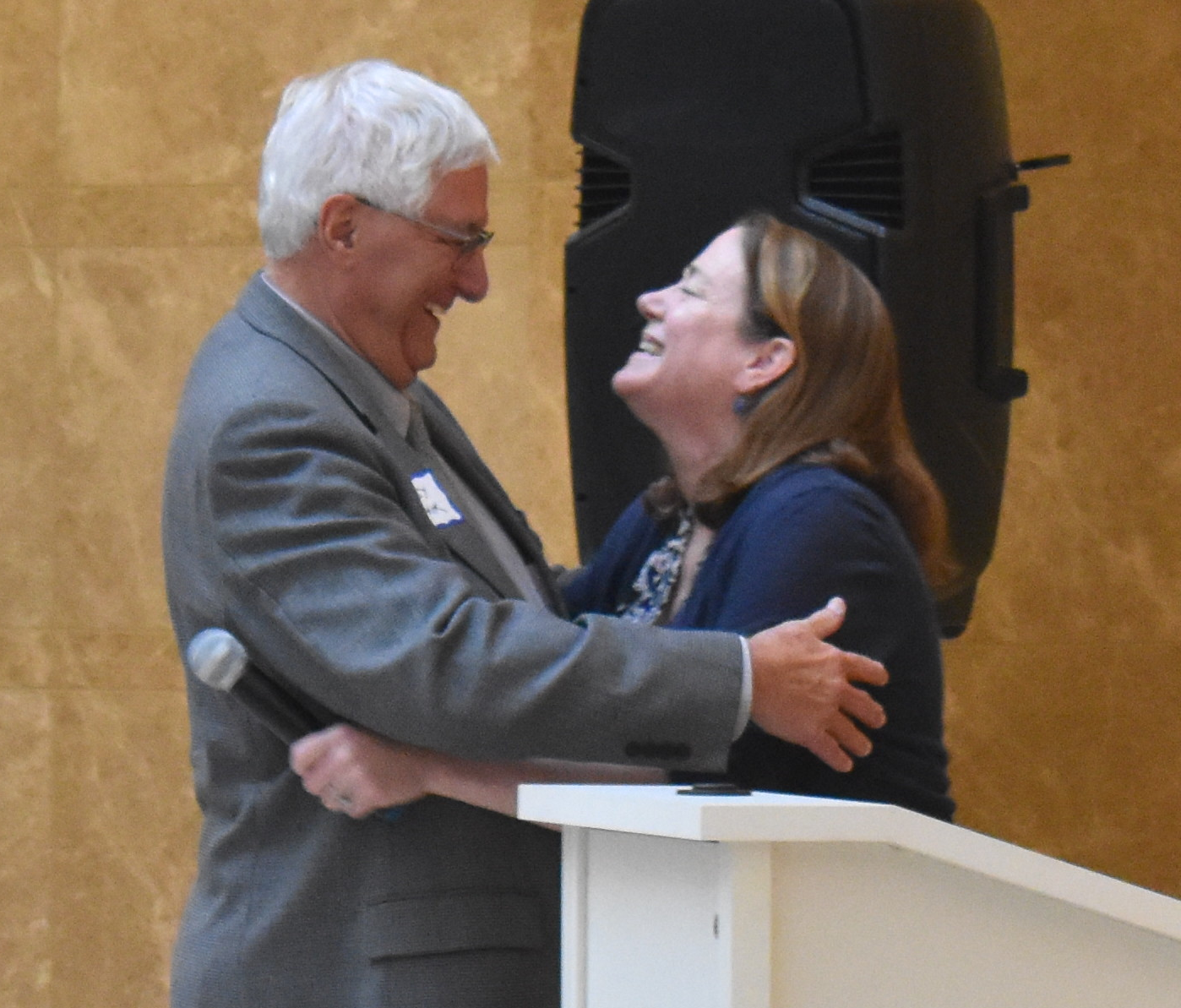
Justice Hart greeting Casey after his talk
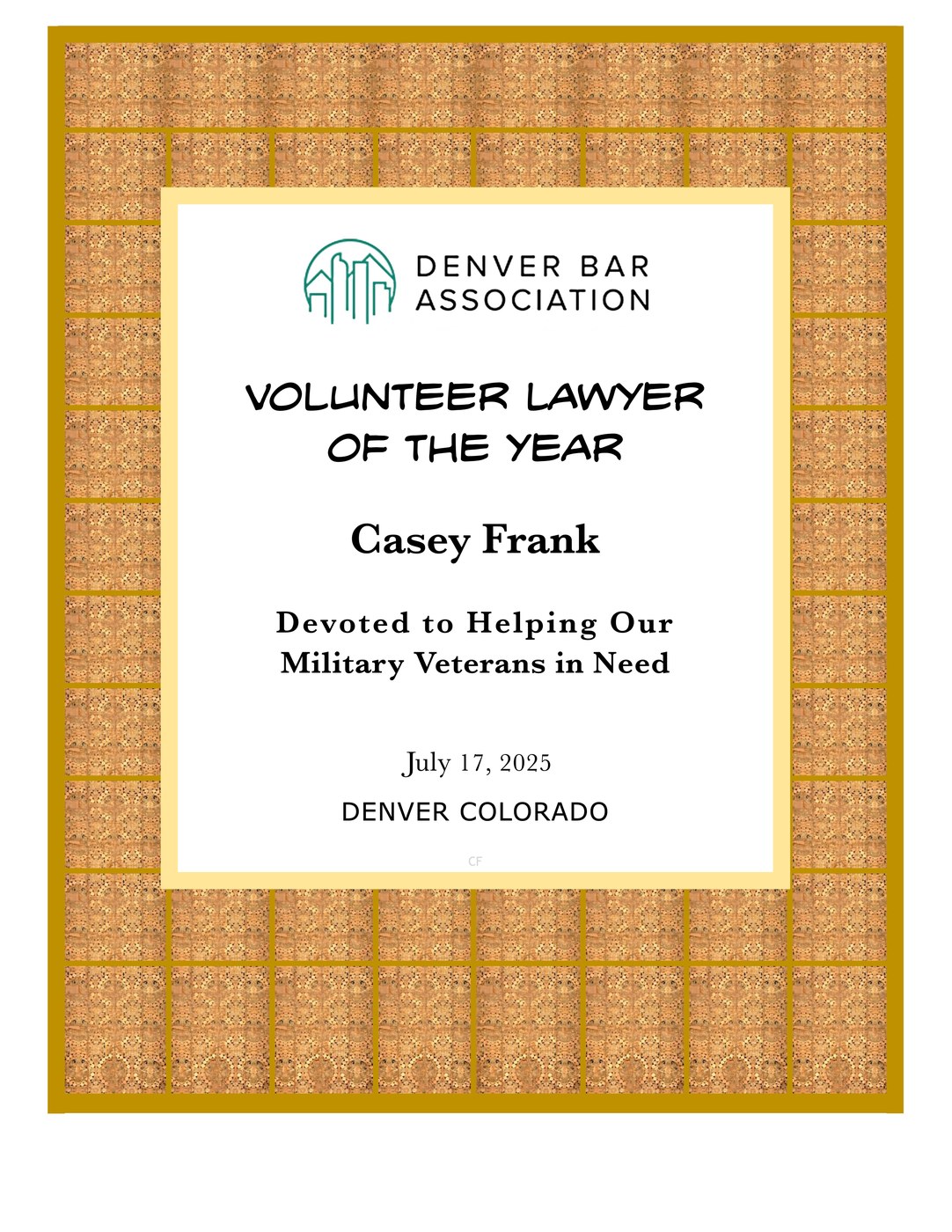
Volunteer of the Year Award at the DBA / CBA
Acceptance Remarks
How to write Pro Bono Adventure Stories
These are short stories showing how pro bono
work is done personally, but felt collectively,
blending legal efforts and felt experience
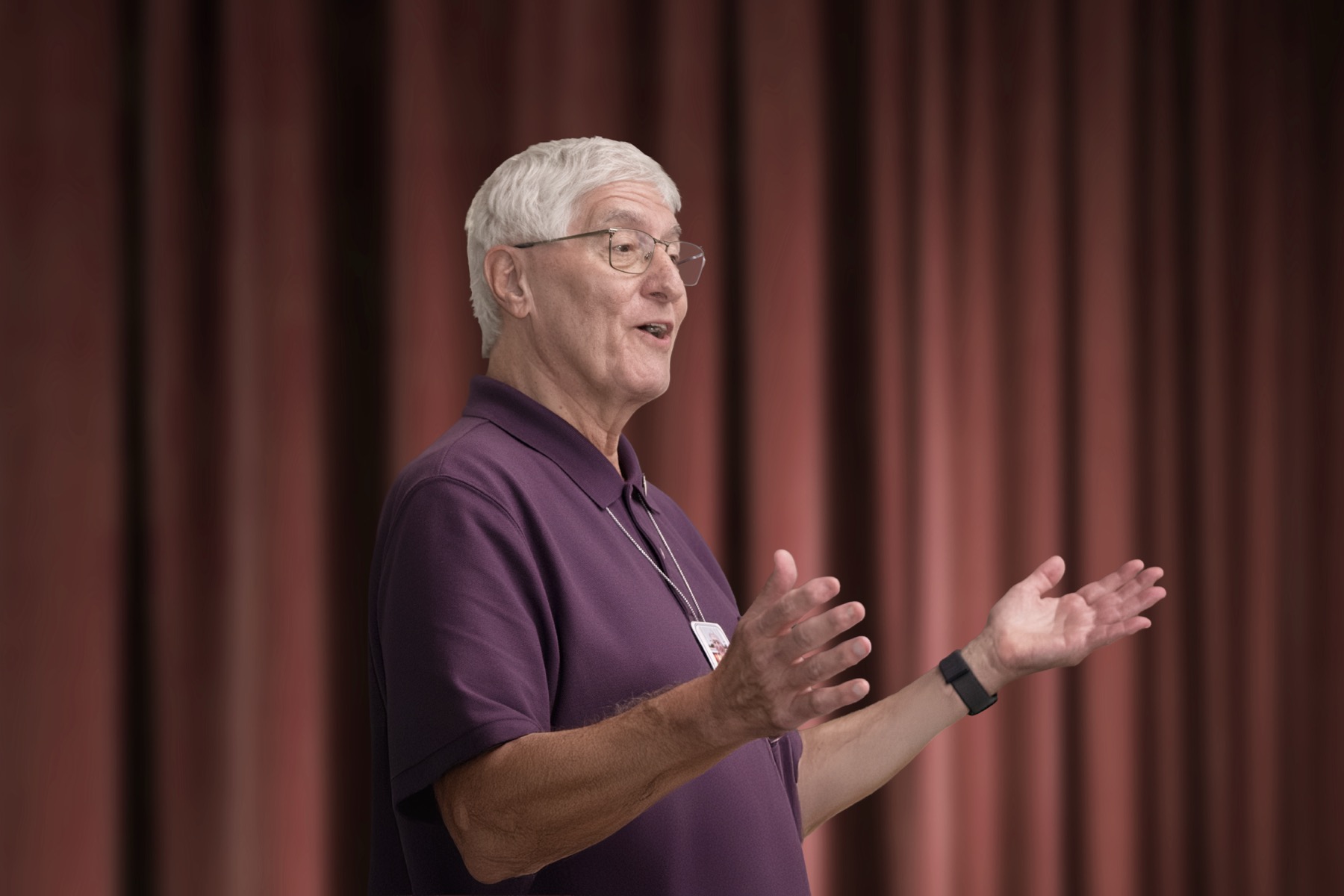
Casey at the 2026 Pro Bono Summit in Colorado Springs
Working with Cognitive Experts 2025, Colorado Trial Lawyers Association “Trial Talk” Journal
This will help you work with forensic psychiatrists and psychologists in court, and is rated highly: “The recent issue of CTLA’s Trial Talk was even better than usual. My favorite article was yours. Having been on the front lines and in all those situations which you describe for 42 years, I will only say: Excellent Job!” — Attorney Alan Higbie, Colorado Springs
Click here to Download
People Who Help Veterans Solve Legal Problems 2026, Welcome Veterans LLC
This is a guide to helping lawyers at the free clinics to solve problems, or find someone who can, and for veterans to take home. It prioritizes locations near the clinics. It avoids organizations who don’t provide lawyers, and most places that just give advice. All phones, emails, and URLs have been confirmed.
Click here to download.
Doing Away with Dogmatic Medical Directives 2022, The Colorado Lawyer
It is unrealistic to make fixed treatment instructions in the present, to be implemented in an unknown time in the future, in unpredictable medical circumstances, carried out by clinicians who are now strangers. This is why, and what we can do about it.
Click here to download.
Who Makes Medical Treatment Decisions? An Algorithm 2021, University Hospital Ethics Consult Service
This shows how medical treatment decisions are made, directly by patients, and indirectly by surrogates. It condenses many laws into an easy-to-follow chart.
Click here to download.
Concise Contracts, 4th Edition 2016, (First Edition, 1996)
The ideas of contracts match the ideas of human relationships. Contracts are simply an unambiguous way to make agreements. Understanding them is an essential part of law school, and is beneficial to anyone navigating our complex modern society. This book is written in plain English as an accessible reference covering the basics.
Click here to download.
End-of-Life Decisions: Who Decides and the Role of the Psychiatrist 2014, Psychiatric Times
This article explores the interplay of law, ethics, and social considerations in support of medicine at the end of life. It pays special attention to the role of psychiatry. Written with Dr. Richard Martinez; originally published in The Psychiatric Times.
Click here to download.
How to Reconcile Advance Care Directives with Attempted Suicide 2013, The Colorado Lawyer
When people are admitted to a hospital following an attempted suicide, their advance directives can raise ethical quandaries. This is a recommended approach to finding consensus in those circumstances.
Click here to download.
What Is “Consensus” When Choosing a Proxy? 2009, University Hospital Ethics Consult Service
Consensus means different things to different people in different circumstances. It is like “semi-annual” and “bi-annual,” both of which have come to mean either twice a year or every two years, and are thus useless for precise language. See how it plays out in using this statute.
Click here to download.
Relatives As Surrogates 2005, The Colorado Lawyer
Family members often make inappropriate medical treatment decisions when they act as surrogates for relatives. Even with the best of intentions, the medical literature reveals that choices by family members have a poor correlation with what their incapacitated relatives actually wanted.
Click here to download.
Surrogate Decision-Making for “Friendless” Patients 2005, The Colorado Lawyer
If a person is mentally unable to make medical care decisions, a substitute decision-maker must do so. As society becomes proportionately older, more people in that situation are likely to also outlive their families and social circles. This article addresses alternative means of substitute decision-making that must then be found.
Click here to download.
Living Wills 1998, In Philip Kapleau, The Zen of Living and Dying
We live in a world of ever-expanding medical treatment options, where more decisions are the responsibility of patients than ever before. Some of the most important medical decisions we will ever make arise as we near the end of our lives. By preparing adequately for death we not only reduce the decision-making burden on our families, we also engender greater clarity in ourselves. Here’s how to do so.
Click here to download.
Living Organs and Dying Bodies 1997, Tricycle: The Buddhist Review
Organ donation raises many issues for religions beyond mere approval or prohibition. The methodology of donation intersects with the passage from this world—a passage that has always been a fundamental religious concern. This article attempts to reconcile specific Buddhist religious teachings about dying, with the needs of organ donors.
Click here to download.
Reconciling Patient Choice with Physician Conscience 1997, The Colorado Lawyer
What happens when the medical treatment to which a patient feels entitled conflicts with the sincere personal objects of the treating doctor? A patient has some right to treatment, yet a doctor also has some right of conscience. These issues will arise more frequently in our era of galloping technology, with patients who are better educated consumers. Whose rights prevail? How should doctors respond to these issues?
Click here to download.
Truman’s Bomb, Our Bomb 1995, The Fletcher Forum of World Affairs
“The United States did not drop atomic bombs on Hiroshima and Nagasaki primarily to end World War II without invading Japan, nor to threaten the Soviet Union at the threshold of the Cold War. Striving to emulate Roosevelt, desensitized by carpet bombing in Germany and Japan, provoked by the alienation between East and West, Truman felt he had to use the Bomb simply because he could not imagine doing otherwise.” [Excerpt from the article]
Click here to download.
The ADA Imposes Burden for Lenders at Foreclosure 1995, Massachusetts Lawyers Weekly
Sometimes, if a bank forecloses on real estate, it must shoulder new responsibilities under the Americans with Disabilities Act — to make the building accessible to the disabled. This can be as inordinately costly as buying a place which is environmentally contaminated. What’s a bank to do? This article advises lenders on how to properly address this issue, both when lending and when considering foreclosure.
Click here to Download.
The ADA and Privately Owned Historic Facilities 1994, The Colorado Lawyer
Society rightly values access for the disabled, recognizing that we are all benefited by universal access to buildings and places. At the same time, we also accord historic buildings special protection from modification. What happens when these needs conflict? How are they balanced? This aricle attempts to reconcile these meritorious rights.
Click here to download.
Protecting Marital Obligations from Bankruptcy 1994, The Colorado Lawyer
Bankruptcy became another weapon in the war of the sexes. Parties to a divorce sometimes tried to undermine the property settlement after a divorce by filing for bankruptcy. This comprehensive article outlined the primary ways attorneys could protect settlements. However, many of the conclusions in this article have been superseded by subsequent legislation, so be sure to update your research on this topic.
Click here to download.
Discovery Made Easier by Computer 1993, The Colorado Lawyer
This seems to be the first article in the Colorado Lawyer on electronic discovery, which means it was pioneering, which means it is now seriously out of date, perhaps interesting as history.
Click here to download.
We Didn’t Get into This Ecological Fix by Lack of Technology 1991, The New York Times
Environmental good health is a matter of our collective personal and social values and behaviors, not the cleverness of our technology. Here’s what I mean.
Click here to download.
Lender Liabilities 1990, New England Waste Resources: Courtroom Report
When a bank or another mortgage holder forecloses on property, they become the new owner. If the property is environmentally contaminated, responsibility for cleaning it up can be inherited along with the property. Steps can be taken to avoid this potentially disastrous problem. This article reviews some related legal and legislative developments.
Click here to Download.